Last time, when I wrote an article about how to manage model sovereignty risk, I concluded that there are two possible approaches to implementing AI agents in complex, real-world corporate workflows. Let’s begin by briefly recapping them:
In the first approach, to carry out every step in a given workflow, we allow a single AI agent to navigate freely across all the systems and documents it can access, in order to solve a multi-step problem,
In the second approach, the steps of the overall workflow are distributed across several agents, each with a narrowly defined scope, with semi-deterministic logic deciding what happens in between.
This distinction mattered from the perspective of model sovereignty risk, because building agentic workflows according to the first approach requires a very powerful model—one of those that have recently become an object of geopolitical rivalry.
Today, I will focus on a more practical and direct question: does it make sense at all to embed the most powerful AI models into agentic workflows?
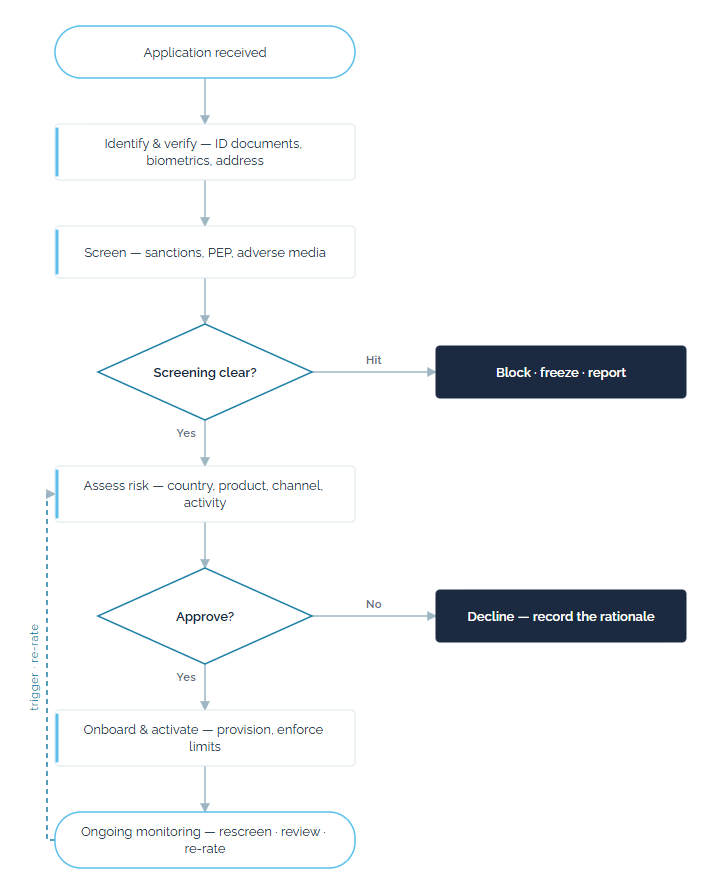
To illustrate the difference between the two approaches, let’s sketch a diagram of a (more or less) typical KYC process. First, here is how it looks from the process owner’s perspective:
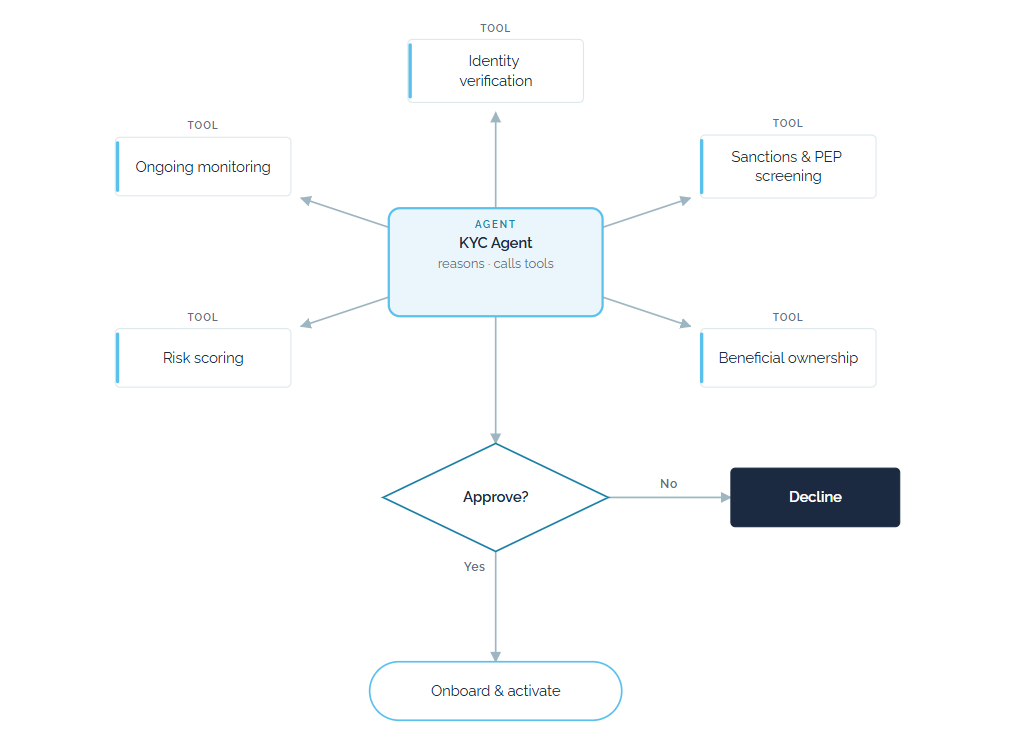
Now, let’s assume we want to automate that process with AI agents. Using approach one, the agentic set-up would look like this:
Using approach two, the agentic workflow would look like this:
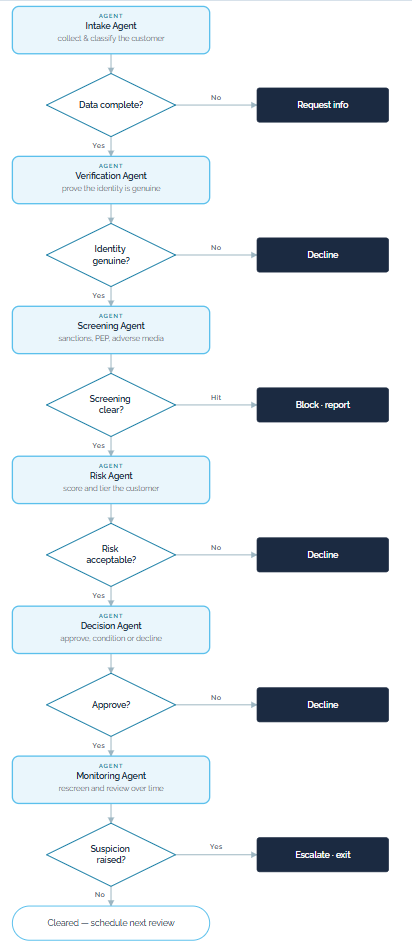
Looking at the complexity of both diagrams, the first approach appears much easier to implement. And it is—with the latest frontier models, we can simply give an agent equipped with the (now back) Claude Fable model the procedure describing the process, plus a process diagram. Or, if the documents are not up to date, we can upload a transcript from a walkthrough meeting with the business owner. We configure the agent’s access to the relevant systems and file storages, and let it run on its own. It will take longer, but it is very likely to produce accurate results (at least on test examples).
Does that sound like an implementation requiring very little effort and promising a high ROI?
Yes, it does.
Does it work in production?
It doesn’t. Believe us—we tried.
Now let’s consider approach two. We have to configure each agent separately, build all the deterministic rules between them, manage conversation history, make sure context is not lost as work passes between agents, and ensure the workflow handles all kinds of exceptions appropriately. We will almost certainly need to test that workflow many times, on many examples and edge cases. Then update it. And repeat until we are satisfied with the final result.
Does that sound like a lot of work?
It is much more work.
Agents developed using approach one—assuming we have configured all credentials correctly—can be tested in a matter of minutes by a tech-savvy business user. Such user can provide all the required inputs to a powerful model like Claude Fable and let it do the work. Then he/she can prompt for borderline cases, analyse the outputs, and tweak the prompts slightly if the results are not satisfactory.
Now, let’s expand a little on the two main differences between the approaches:
Difference 1: Approach 1 requires a powerful model, whereas approach 2 might run on smaller ones
This means that, despite the lower initial implementation cost, approach one will be more expensive to run. For understanding the process—crunching transcripts from walkthrough meetings, merging their content with process diagrams and process documents—you need a great deal of intelligence (and therefore a powerful model is genuinely helpful). But when it comes to execution, KYC (like many other processes in finance) is highly repetitive. You do not want the most capable—and most expensive—model to rerun the same KYC analysis for every prospective (and existing) customer, consuming large volumes of costly tokens in the process.
A group of smaller, more focused agents can do this much more cheaply (and faster). Those focused agents can run on less capable models—and there are many of these, so the choice is abundant. By contrast, an agentic workflow designed according to approach one depends on the very best models, of which there are few, and which—as we have seen recently—are subject to geopolitical risks.
Difference 2: Offloading knowledge to a machine reduces trust and control over the process
The truth is that the more of a process we delegate to AI, the more control we lose over its course (even if we are happy with the final outcome). This applies to all tasks we can offload to AI: analysing data, running a process, writing code. The moment we move away from giving an agent precise instructions and instead ask it simply to “solve a problem” or “draw conclusions” (a trap that even the author of this blog entry sometimes falls into), is the moment we begin losing control over what the AI is actually doing.
The same applies to our KYC process. In production, exceptions will inevitably occur. If we choose to outsource the entire process to AI, there will come a time when no one fully understands it (even those responsible for the implementation—assuming they are still reachable by the time the exceptions surface). Trust in the process will erode, and there will be no clear accountability if things go wrong. Decision-makers will eventually agree to revert to a pre-AI manual process, and blame AI for “not delivering according to expectations”.
By contrast, approach two requires collaboration from the outset—between business owners and the implementation team (as in any software development effort that works properly). The agents are simple enough that anyone can understand them. And the redesigned agentic workflow still mirrors how business users see the process, making it comprehensible to them. Agent mistakes and hallucinations surface quickly and can be fixed easily. We reduce the cost of running a process (and potentially increase its accuracy), while maintaining control over that process.
In many of our implementations, we often recommend not using any AI at all to automate a given workflow—where possible, we prefer predictable, deterministic, and controllable rules. After all, finance is about money—things that are too important to leave to a machine that bears no legal responsibility (although some try to challenge that: Javier Milei, Argentina’s president, recently announced he will support the creation of a “non-human corporation” type of legal entity).
The conclusion? AI can do many things. In fact, it is capable of doing most knowledge-work tasks. But AI alone does not build trust, and trust is the foundation for running any process efficiently. That is why we are optimistic that AI is still a long way from making us humans redundant.